
The script
Hello, and good morning. This is Ravindra Warang, and you're listening to Pharma Explained. In today's episode, we're looking at how a breast cancer medicine with a price of about 696 rupees will cost 73 from Monday, and who might miss out on a 40-dollar-a-year HIV prevention shot.
On the 17th of October, the National Pharmaceutical Pricing Authority, which everyone calls NPPA and which keeps an eye on medicine prices, issued an order using a special power under the drug price control law. It says that on 137 anti-cancer drugs, the trade margin can be no more than 30 percent of the MRP, the maximum retail price printed on the pack. Companies then filed new prices, and last week ETV Bharat reported that NPPA had published revised MRPs for 543 brands, based on filings up to the 27th of October, with more to come. They apply from Monday the 9th of November.
The trade margin is simply what gets added between the factory and you. A medicine goes from the manufacturer to a distributor, then to a chemist or a hospital pharmacy, and each of them keeps a share. Add those shares up and you have the trade margin. If a pack has an MRP of a hundred rupees, the order says all of them together can keep at most thirty.
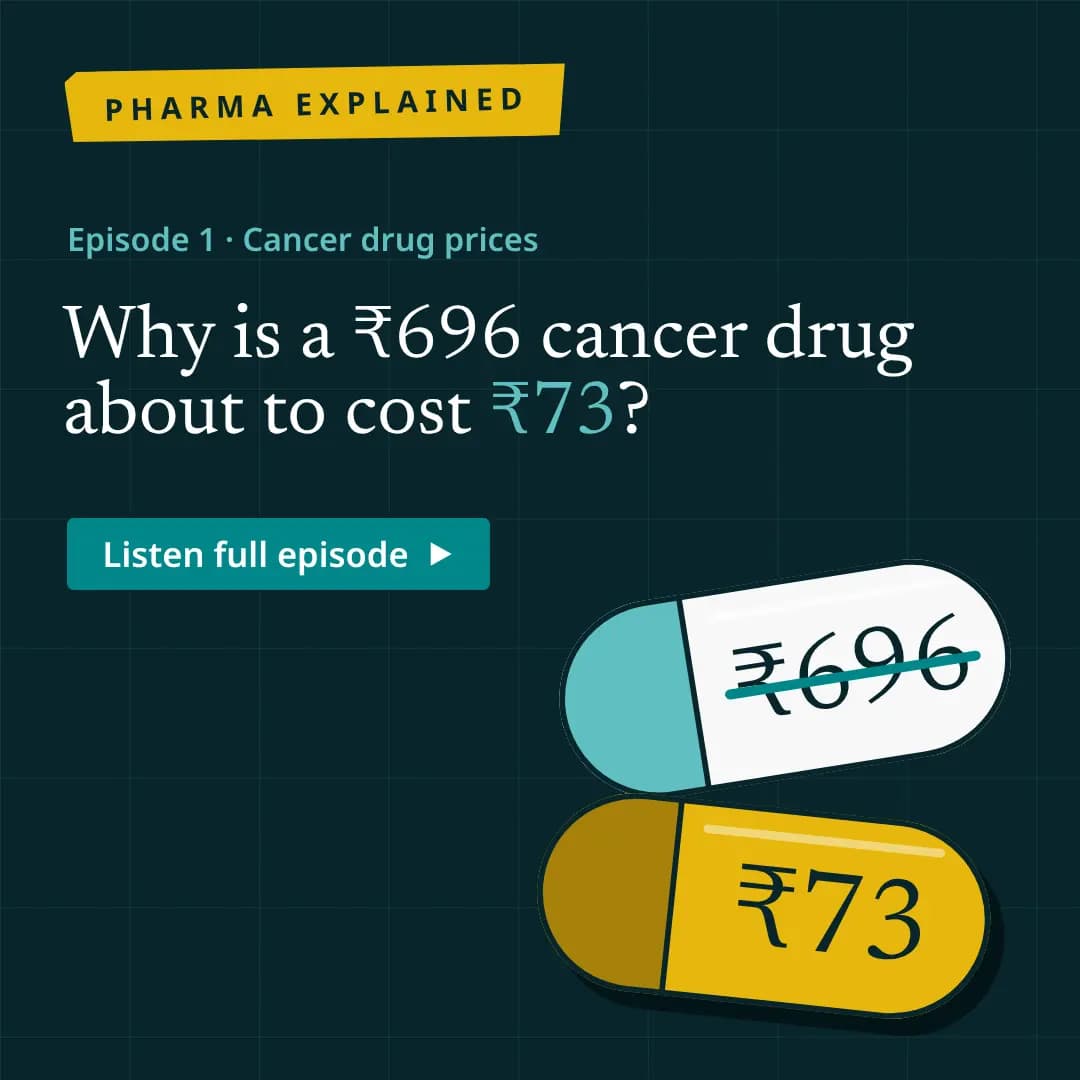
The reason for starting with cancer drugs is in the numbers. Minutes of an NPPA meeting on the 8th of October, which cite data from Pharmarack, put the average markup on these medicines at around 170 percent, and for some of them it went as high as 700. As we read it, the order doesn't tell manufacturers what to charge in the first place. It limits what gets added after that. That's how the anastrozole pack goes from 696 rupees to 73, and a vial of bevacizumab from Abbott goes from about 21,800 rupees to about 5,900.
On safety, nothing changes directly. NPPA has told manufacturers to keep supplying at current levels so that nothing runs short, hospitals have to charge the new prices, and state drug controllers are supposed to enforce it. Whether supply actually holds is still unknown.
For patients, cancer treatment usually goes on for a long time, so a smaller monthly bill might make it easier to stay with it. That's only our guess.
On the wallet, the government says prices should fall by up to 70 percent, but the examples in the revised list go further than that. By our arithmetic anastrozole falls by almost 90 percent, and a few other brands fall by more than 70. We can't tell you why the official figure and the examples don't match, so the safest thing to say is that it varies a lot from brand to brand. If you buy one of these medicines after Monday, it's worth comparing the MRP on the pack with the revised list, and if you think you're being overcharged, you can raise it with the pharmacy or your state drug controller.
Beyond India, nobody has measured a global effect yet, but capping the margin rather than the maker's price is a different tool from the usual one.
Some people say it doesn't go far enough. A representative of the Jan Swasthya Abhiyan, a public health network, told the Sentinel in Assam that the policy leaves out the expensive, single-source, patented cancer drugs. That's one outlet and one unnamed person. It's also a little puzzling, because the government's own release names pembrolizumab, durvalumab and osimertinib as examples of drugs that should become more accessible. We haven't seen the full list of 137 drugs, so we can't say which of the costliest medicines are actually covered.
The question we'd leave you with is this: the cap trims what the chain adds, but for the newest cancer drugs, who decides the price in the first place?
The second story is about an HIV prevention injection called lenacapavir. On the 2nd of November the US FDA gave Dr. Reddy's a tentative approval for a generic version. Tentative is the usual status for a generic while the original is still under patent, so it can't be sold in the US yet.
It's an injection taken twice a year instead of a daily pill. Unitaid says the price will be 40 dollars per person per year in 120 low- and middle-income countries covered by Gilead's licence, and MSF says Gilead's price in the US is about 28,000 dollars. First supplies are expected before the end of this year, with wider availability in 2027.
MSF's point is that depending on a company's voluntary licence has limits. It says at least 26 middle-income countries, including Brazil and Mexico, are left out, and that Gilead refused in March to sell the drug to MSF at any price. Gilead says its approach combines supply at no profit, royalty-free licences and regional agreements, with enough drug for up to three million people through 2028. We couldn't confirm whether India itself is on the list of 120 countries, so we won't guess.
One more thing on the cough-syrup ingredient order from last time. Business Standard reported on Tuesday that industry wants CDSCO to say whether it covers exports, and warns of delays for small manufacturers and short-staffed state offices. CDSCO hadn't replied when the report came out.
On Monday the 9th the new cancer-drug prices take effect, and more brands may be added by then. We'll also be watching for CDSCO's reply on the solvent order, and for the first generic lenacapavir supplies before the end of the year. If you'd like the detailed story behind any of this, with the sources and the full numbers, you'll find it on the Pharma Now website and in the Pharma Now mobile app. That's Pharma Explained for today. Until next time, stay curious and stay well.